Blog
English learning tips, guides, and news from WELE
Search results for "ai" (26 posts)
Clear
Legal English: Vocabulary by Practice Area and a Roadmap for Practitioners
Legal English vocabulary organized by the practice areas you actually encounter, plus a three-stage roadmap for practitioners and four self-study resources with transcripts to check against.


Lay's Past Tense Is Laid: The Other Half of the Lie vs. Lay Mix-Up
The simple past and past participle of lay are both laid. This page covers the transitive half of the lie/lay pair, and where laid loses its d when native speakers talk fast.

English for the Garment Industry: Factory Vocabulary, a Learning Roadmap, and Reading Resources
Garment industry vocabulary organized by real factory jobs, plus a three-stage roadmap from tech packs to buyer emails, and self-study resources worth reading.

The Past Tense of Want Is Wanted: The /ɪd/ Ending, Want vs. Won't, and When Wanted Sounds Just Like Want It
Want is a regular verb; both the simple past and the past participle are wanted. The tricky parts are the /ɪd/ ending that often drops, the want/won't pair, and when wanted sounds exactly like want it.

The Past Tense of Walk Is Walked: Silent L, the /kt/ Ending, and the Walk vs. Work Trap
Walk is a regular verb — both the simple past and the past participle are walked. The tricky parts are the silent l, the final consonant cluster that often gets dropped, and the walk-work pair that sounds almost identical.
The Past Tense of Lie: Lay, Lain, or Lied — Untangling Lie vs. Lay
Lie meaning "to recline" has the simple past lay and the past participle lain, while lie meaning "to tell an untruth" is lied. The confusion is that lay is also a different verb — one in the present tense.

Learning English with AI: Where It Shines, Where It Falls Short, and How to Use It Right
AI is great for unlimited speaking practice and error correction, but understanding real people when they talk takes a different kind of practice that AI can't produce.

Accounting English: Vocabulary, Study Roadmap, and Self-Study Resources
Accounting vocabulary by topic, easily confused word pairs, a three-stage roadmap for working professionals, and four self-study resources with transcripts for dictation practice.

Logistics English: Vocabulary, Listening Skills, and a Self-Study Path
Logistics vocabulary grouped by real job functions, how to train your ear for abbreviations on calls, plus a three-stage self-study path and resources from people in the industry.

The English Alphabet: 26 Letters, How to Say Each One, and How to Spell Things Out on the Phone
Knowing the alphabet from A to Z and knowing how to say each letter's name correctly are two different things — and only the second one saves you when you have to spell out an email over the phone.

Daily English Listening Practice: A 20-Minute Routine That Actually Sticks
Listening every day and still stuck in place usually isn't because you haven't listened enough — it's because you're listening in a way that doesn't make your brain work. The 20-minute framework below fixes exactly that.
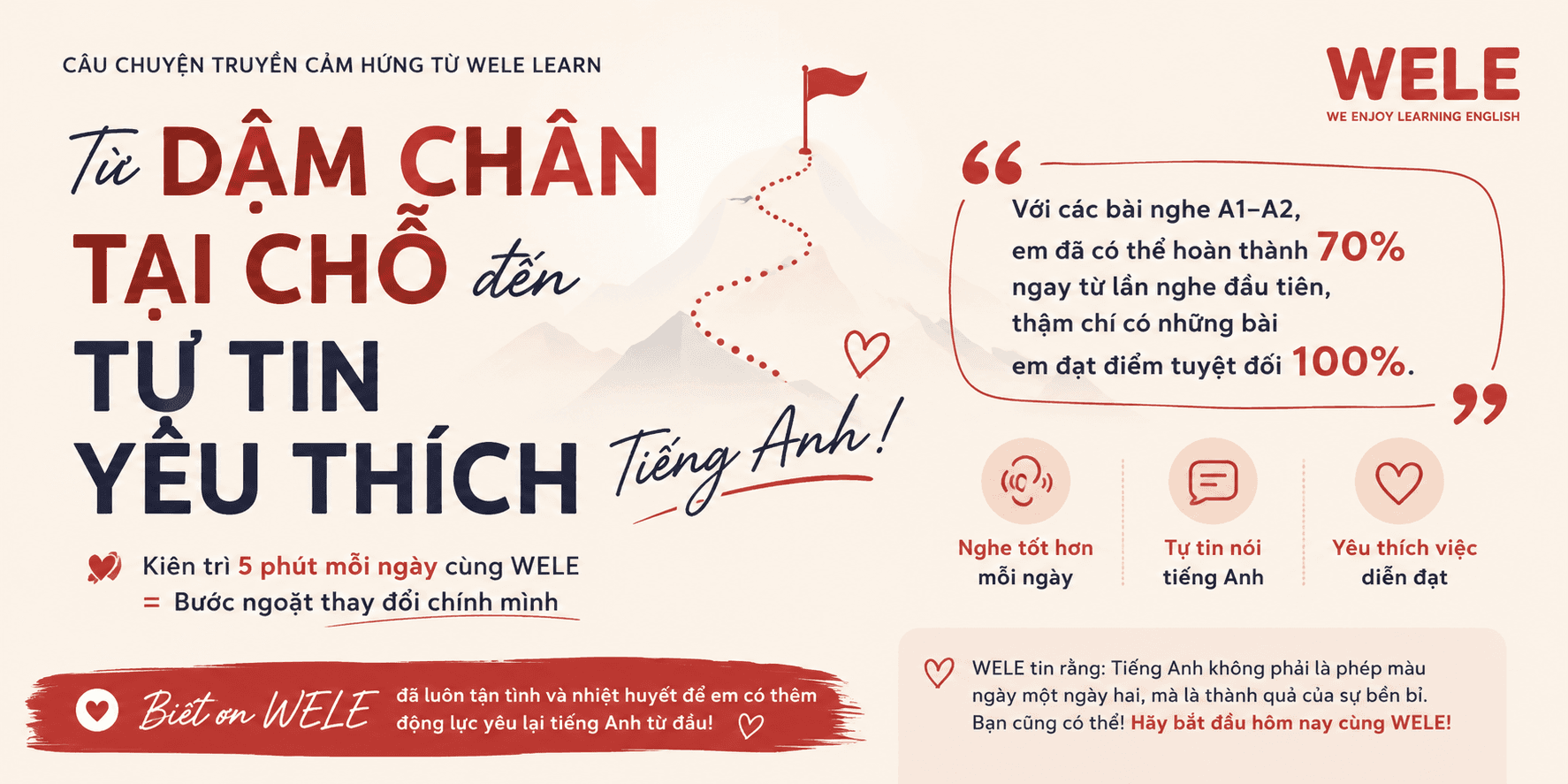
From Zero to an Exciting Comeback: Reclaiming English
"Once scoring less than 20% on even the simplest listening exercises, a Đồng Hành scholarship student kept at it, spending at least 5 minutes a day practicing listening with WELE. Today, that same student can score 70-100% on the very first listen and feels far more confident using English. It's not magic — daily persistence is what made the change happen. Heartfelt stories like this one are what keep WELE motivated to keep spreading the joy of learning English to young people across the country, especially those facing hardship. Thank you for trusting WELE and journeying together toward mastering English! ❤️"

How to Prepare for TOPIK Listening with Daily Dictation Practice
Prepare for the TOPIK listening section using WELE's dictation method. Get a structured study plan, learn common question types, discover frequently tested vocabulary, and understand why daily transcription practice outperforms traditional test prep.

Master Korean Listening: Sound Changes Every Learner Must Know
Korean pronunciation rules transform how words actually sound versus how they are written. Learn the five essential sound change rules — liaison, nasalization, aspiration, tensification, and palatalization — and how to use WELE dictation to master them.

Kim Ngọc – English Teacher Training Student
WELE: Thank you, Ngoc, for agreeing to this interview with the program. What year and major are you currently in? Ngoc: Right now I'm a K18 student majoring in English Pedagogy (I'm a final-year stude...

From Zero to B2: A Detailed 12-Month Plan
Want to reach B2 level in 1 year? Here is a detailed roadmap with WELE and supplementary resources.

Classroom Feature: How Teachers Manage Students
WELE has a Classroom feature for teachers to create classes, assign lessons, and track student progress. Detailed guide.

How to Use AI Feedback in WELE to Improve Faster
WELE uses AI to analyze mistakes and provide personalized suggestions. Learn how to make the most of this feature.

Streak Feature: The Secret to Daily Learning Motivation
What is Streak and why does it help you learn English more consistently? Discover the power of gamification in learning.

WELE vs Speechling: Which is the Best Listening App?
Speechling focuses on pronunciation with human coach feedback. WELE focuses on listening comprehension with dictation. Detailed comparison.